Like diamonds, sapphires and rubies, emeralds are distinguished by their uniquely beautiful color. Dark green to blue-green, the color (due to traces of chromium and vanadium) of emeralds varies according to the deposit. This precious gem belongs to a variety of beryl, like aquamarine and pink morganite. Prized by queens since antiquity (notably Cleopatra), and appreciated by celebrities, this gemstone is nevertheless difficult for many to recognize. Planetys explains how to recognize an emerald and avoid confusion.
Emerald properties and virtues
Like other natural gemstones, emeralds have many virtues in lithotherapy. The main emerald deposits are found in Colombia and Pakistan. Rest assured, you don’t need to travel the world in search of emeralds to benefit from the gem’s virtues. You’ll find them on Planetys in the form of competitively priced jewelry. Discover here the physical and spiritual benefits of emerald.
Benefits for the body
Emerald is known to regenerate and strengthen the digestive system. But the power of this gemstone goes far beyond that. Worn as a piece of jewelry (ring, pendant…), emerald brings you a range of benefits:
- Soothes eyestrain and eye disease,
- Calms migraines,
- Fights certain infections (flu, angina, ear infections…),
- Detoxifies the liver and pancreas,
- soothes joint pain,
- Stimulates digestion,
- Gives energy.
This list of benefits is not exhaustive. Emerald alleviates many other ailments, including epilepsy. Its soothing green color brings peace and harmony to the wearer.
Psychic benefits of emerald
A stone of love, knowledge and harmony, emerald brings inner calm and soothes passions. This gemstone is recommended for those seeking balance in their lives. Emerald also promotes forgiveness. The green crystal stimulates memory and promotes learning. It favors openness to others and encourages benevolence, while fostering a love of working together.
How to choose a quality emerald
From the beryl family, emeralds are green, but their shade and depth vary according to their rarity. To choose an emerald of excellent quality, you need to take into account the color, clarity and cut of the gemstone.
Select the right shade of green
An emerald’s color is the most important criterion influencing its overall value. It is assessed according to hue, tone and saturation. An emerald’s hue refers to its overall color. It includes the shade of green and all other shades possessed by the gemstone.
The most beautiful emeralds in the world have an intense green color. Their shades (if any) should be blue rather than yellow. The best-quality stones also have a uniform coloration with little or no color zoning. Tone refers to the depth of color of an emerald. Green beryl can have a light, medium or dark tone. Finally, the most precious and attractive gems are characterized by a medium to moderately dark tone.
Saturation is a word used to describe the purity of emerald color. An emerald with an intense green color, with or without a hue, is an emerald with good saturation. A gem with high saturation will have intense hues and a dull green color. Stones with good saturation are prized in jewelry, as they reflect light well, with greater brilliance.
Check emeralds for visible inclusions
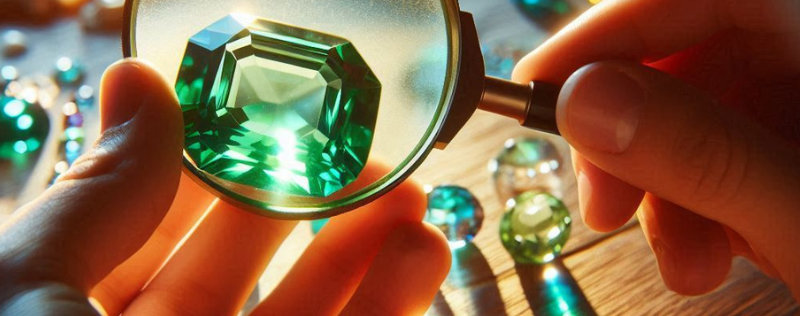
Virtually all gems have inclusions that can be observed with a magnifying glass. Inclusions can be mineral fibers, liquid droplets, particles of other crystals or tiny fissures. Most of these inclusions were trapped inside the emerald during its formation.
In gemology, they are also known as the “emerald garden”. It is virtually impossible to find an emerald without inclusions. The absence of inclusions could mean that it is glass or crystal. It is therefore preferable to find a stone with few inclusions, but with good clarity.
Emerald clarity refers to the number, type and location of inclusions in the gem. An emerald of good clarity is one with a limited number of tiny inclusions that do not affect the overall beauty of the stone.
Emerald size
The size of an emerald is a determining factor in the beauty and quality of this gemstone. Rough stones are hexagons. Depending on the emerald’s inclusions and color nuances, the jeweler or lapidary cuts the emerald to optimize its beauty and performance.
This crystal can be cushion, princess, round or pear-shaped. Emerald cut greatly affects its final beauty. A good quality cut hides emerald inclusions and enhances light reflection.
What is emerald cutting?
Whether from the mines of Russia, Zambia or Brazil, emeralds have become so popular that gem cutters have created a new type of cut in their honor: the emerald cut. The emerald cut gives the gemstone a rectangular (or square) shape, with cut sides that enhance the gem’s color and luster. When emerald-cutting, specialists take care to reinforce the stone against any pressure that might damage it.
Emerald cutting
Possible confusions and imitations
Bear in mind that not every green stone is an emerald. Scams involving this gem are common, as it is particularly difficult to distinguish a fake stone from a real one with the naked eye. So be careful when buying emeralds. For your jewelry, opt for a store like Planetys, which has acquired a certain reputation and can provide you with a certificate of authenticity.
Emerald can easily be confused with certain natural stones. Examples include aventurine, fluorite, diopside, peridot and demantoid. The three stones most often confused with emerald are garnet, green tourmaline and glass. Imitations are also common. A doublet is a process designed to deceive the buyer. It consists of assembling glass with a thin sheet of emerald or other green-colored substance. There are many doublets on the market, so you need to be careful.
What is a synthetic emerald?
A synthetic emerald is a stone manufactured by man in a laboratory, using sophisticated equipment designed to reproduce the characteristics and properties of the original stone, almost to the letter. The first synthetic emerald was created in 1848 by anhydrous dissolution.